Friday, March 16, 2012

Misconception of Communism and Animal Farm


Misconception of Communism and Animal Farm

            The book Animal Farm by George Orwell was challenged by the New York State English Council Committee in 1968 because the author was a supposed ‘communist’ (“Banned”). Orwell’s book impresses on people the idea of a world where people, or in this case, animals, have no personal freedom. The animals had always dreamed of a world where they did not live under human rule. Before they knew it, the Rebellion, as they called it, had effectively taken place. They all pledged loyalty to their new ‘Animal Farm’ and their basic communist community was working. That is, until Napoleon, a pig, let power go to his head, expelled another pig, Snowball, and practically became a dictator. Orwell meant this happening in his book to represent the Soviet Union at the time. Napoleon represents Joseph Stalin and Snowball as Leon Trotsky. Orwell’s Animal Farm portrays an idea of communism and thus it was challenged, but one must take into consideration that the concept of communism is, most would say, perfect, just ruined by imperfect people.
            The Florida Center for Instructional Technology states communism as, “A concept or system of society in which the collective community shares ownership in resources and the means of production. In theory, such societies provide for equal sharing of all work, according to ability, and all benefits, according to need” (“A Teacher's Guide to the Holocaust”). Based on this definition only, if one was to hear that a book was banned because the author was a communist, that one person would think it’s crazy. Ideally, communism is perfect. Perfection, some would say, is about being equal and that’s exactly what communism is; it’s equal sharing in work and profit. Although there aren’t any perfect communist societies on the earth, one can imagine that the world would be devoid of prejudices and homeless people. The problem here lies that most of the world’s population just can’t work with it (Hoyt).
 There are many places in the world that are still in communist control today. They all had tried (and failed) to create a communist community. Places like China, North Korea, and Vietnam are countries that are still run with communism, though, not run with the communism that was just defined. One example of a communist country from the author’s time, and one of the most commonly spoken of, is Soviet Russia. Formed in 1898 and lasted until August 1991, Soviet Russia was relatively fine in the beginning. Then, not even a decade later, things started to change when it became a privilege to become a member of the Communist Party of the Soviet Union, commonly known as CPSU. Things were becoming less equal by the day. Under Joseph Stalin the Soviet Russia turned into something more of a dictatorship then a communist society. Stalin started giving the CPSU more privileges and more leave-way in their duties warning the officials “not to give excessive attention to their ‘economic work,’ that is, their efforts to assure the implementation of the fire-year plan by the government of the USSR” (Harris 4). That seemed to be the start of the downfall for a lot of attempted commusistic places. What’s wrong with communism in the world is the people, not the actual thing itself. It’s when the people start to become too controlling and one person becomes a dictator-like leader.
So when the New York State English Council Committee challenged the book saying that Orwell was a communist what they were saying was that Orwell was supporting dictatorship ideals. This was thought because in Animal Farm, Orwell made the description of his animal characters represent people from Soviet Russia. Joseph Stalin being blantly represented as the pig Napoleon and animalism being the term for communism in this book. In the book, the animals started to get an idea of freedom from their human owner, Mr. Jones. Some believe Jones to resemble the last Czar of Russia, Nicholas II. There are some animals like the horses, who portray the working class. Boxer and Clover were described as “their most faithful disciples”  (Orwell 20). Orwell is saying that the working class was the most devoted to the cause of communism/the cause of their leader. Even when times got the tough, “whatever happened she would remain faithful, work hard; carry out the orders that were given to her, and accept the leadership of Napoleon”  (Orwell 97-98). This was the enduring loyalty of the working class. Communism was also sort of a touchy subject in America at the time of Animal Farm’s publishment because it was right in the middle of Stalin’s rule and near the end of Hitler’s reign. Challenging the book seemed to be what the New York State English Council Committee were doing to save the evil ways of communism from their children; somehow protecting them from ever having to deal with such things if they were not taught in their schools.
But the literary value is so much more than that. Animal Farm’s historical content is amazing seeing how it’s taken the happenings of the USSR and turned it into a creative story that students are actually able to follow. Also, if the teachers and parents were concerned of exposing their students and children to all that Stalin did and were worried with the kids getting crazy ideas of living in their own communist society some day, they should take into account the words of George Santayana when he said, “Those who cannot remember the past are condemned to repeat it.” People are afraid that might happen with the Holocaust and Hitler. Educating the children of today ensures a better tomorrow. Animal Farm shows great examples of allusions, seeing how everyone knew to what he was refering to when Napoleon and ‘animalism’ were talked about. This book gives examples of allusions and historical content in a way that had not been presented before: with animals.
I think that when the New York State English Council Committee put up the book Animal Farm by George Orwell on a list to be challenged they were over-reacting. In my eyes they were taking his words too seriously. I believe Orwell was using a book as a satire for the world events that were going on around him. A satire meaning:
A manner of writing that mixes a critical attitude with wit and humor in an effort to improve mankind and human institutions. Ridicule, irony, exaggeration, and several other techniques are almost always present…The satirist's goal is to point out the hypocrisy of his target in the hope that either the target or the audience will return to a real following of the code.  (Nellen)
Orwell used some of those techniques in his book to create this element that the New York State English Council Committee obviously didn’t pick up on. Orwell was critizing Soviet Russia to point out the wrong in it. I do not agree with their reasonings as to why they put Animal Farm up for banning. The book has too much potential for impact to be banned from a place. It certainly has made me look at the USSR, and communism in general, differently. And I’m just one person. Imagine a whole classroom of teenagers, kids, or adults having a paradigm shift with communism in mind. The literary devices in this story are used wonderfully in new creative ways; so even English teachers could enjoy making references to Orwell’s book when teaching about symbolism, allusions, satires, or story telling. I believe that even considering putting this book up for question is senseless because of it’s literary value, it’s impressive literary devices, and the important historical context within it that people should learn.


Works Cited


 “A Teacher's Guide to the Holocaust.” Fcit.usf.edu. Florida Center for Instructional Technology. 2005. Web. 20 Feb. 2012.
“Banned and/or Challenged Books from the Radcliffe Publishing Course Top 100 Novels of the

            20th Century.” Ala.org. American Library Association. 2010. Web. 18 Mar. 2012.

Harris, Jonathan. Subverting the System. Oxford: Rowman & Littlefield Publishers, Inc., 2004. Print.
Hoyt, Alia. “How Communism Works.” HowStuffWorks.com. HowStuffWorks, Inc. 25 Feb. 2008. Web. 20 Feb. 2012.
Nellen, Ted. “Project: #19 Satire.” Tnellen.com. Web. 18 Mar. 2012.

Orwell, George. Animal Farm. New York: Harcourt, Brage & World, Inc., 1946. Print.

Saturday, March 10, 2012

Poem of Friends


Lost in the darkness
Although never knowing light
Their souls silently searching
Never willing to give up this fight

Jason & Eric:
These two with smiling faces
Traveling aimlessly
Without cause, though all the phases

Still not concisely aware
Of their soul’s urgent plea
What life has to bring ‘em?
They would just have to wait and see

Now in high school
They’ve made it this far
Are now searching
For who they really are


Then one night
Unexpectedly
A girl gave Eric a glimpse
Of what he might turn out to be

Promises of eternal happiness,
Of ward families, new friends;
All of these blessings
Seeming never to come to an end

His heart beated a lil’ faster
His mind flung open like a door
Was this finally it?
The thing he had been waiting for?

A girl gave him a special book
A couple months later
It was filled to the brim with stuff he
wanted to live by,
Examples set by The Maker


Still carrying a translating book
Jason never truly felt included
Some things his teachers said
Still continued to elude him

Then he met a group of guys
Who were excepting of everyone
How he hoped they’d all be friends
Always there for each other in the long run

He started going to their early morning
classes
Never regretting the missed sleep
And he found out so much more than
That their friendship ran deep


Jason & Eric
These two with smiling faces
Finally finding their purpose
With new friend’s embraces

The girl from that one night
And the group of boys from school
Had them talk to some of their friends
Only 20 & 21? ... Yeah they were pretty cool

Accepting all that was taught
They set up a date
December 10, 2011
It felt like their fate

Going every Sunday
They never ceased learning
Continually feeling
A great fire burning

And this is where we stop
Although the end is nowhere near
For Jason & Eric have learned
Whosoever belongeth to His church, need not fear

Monday, January 30, 2012

Patrichal Blessings


Patrichal blessings-
One of the most important blessings available to worthy members of the Church is patriarchal blessings. They verify the divinity of Christ and the truthfulness of the Church. These sacred blessings also strengthen the testimonies of those worthy persons who are the recipients of such blessings, provided those recipients live so as to merit the blessings pronounced therein.
          1.     An inspired blessing declaring a person’s lineage (the tribe of Israel to which he/she belongs) and giving insight about his/her life
          2.     It may include promises of blessings the person may receive, warnings about particular temptations or weaknesses, or counsel about how the person should live
·        Our testimonies can be strengthened and fortified and our lives given greater purpose every time we read and reread our patriarchal blessings. Each blessing is absolutely qualified and given upon the condition of the faithfulness of the recipient of the blessing.
          3.     It is given once in a person’s lifetime by a stake patriarch
·        These chosen men live lives that entitle them to the inspiration of heaven. The office of patriarch is one of the great separate priesthood offices of the Melchizedek Priesthood. The patriarchal office is one of blessing, not of administration, nor of counseling. It is a sacred, spiritual calling that usually will continue the remainder of the patriarch’s life
          4.     It is recorded, and a copy is given to the person receiving the blessing. A copy is also kept in the archives of the Church
          5.     It is a sacred and personal document that should be read and studied often but should not be shared casually with others
·        Patriarchal blessings should be read humbly and prayerfully and frequently. They are very personal but may be shared with close family members. A patriarchal blessing is a sacred guideline of counsel, promises, and information from the Lord. However, a person should not expect that the blessing will detail all that will happen to him or her or be an answer to all questions. The omission of the blessing of a great event in life such as a mission or marriage does not mean it will not happen.
Your Patriarchal Blessing(1980) – President James E. Faust
Adoption into the House of Israel
There are many coming into the Church who are not of the blood lineage of a specific tribe of Jacob. No one need assume that he or she will be denied any blessing by reason of not being of the blood lineage of Israel.
Paul makes repeated references to adoption into the house of Israel through faith: “But ye are not in the flesh, but in the Spirit, if so be that the Spirit of God dwell in you. Now if any man have not the Spirit of Christ, he is none of his” (Rom. 8:9).
It really makes no difference if the blessings of the house of Israel come through the lineage or through the spirit of adoption. Elder John A. Widtsoe stated, “Whether this lineage is of blood or of adoption does not matter.” 2
 (Abr. 2:10).
Lineage
Since families are of mixed lineage, it occasionally happens that members of the same family have blessings declaring them to be of different lineage. children from the same parents could belong to different tribes.
Believing Gentiles, even though not of the blood lines or genealogical ancestry of Israel, become adopted into the house of Israel.

Friday, December 16, 2011

AP Statistics Final Essay: LDS Dating


AP Statistics Final Essay: LDS Dating

We decided to do this experiment because it’s something that hits close to home. People say that one shouldn't waste time on things that they don’t have any connection with or they won’t be inspired to go further or make sure it’s done correctly. So because of this reason, we wanted to do an experiment that we had an association with. Hannah and I have lived our whole lives in the LDS church hearing the standards for the youth, one of which being not to date until you are 16 years old. Since we've both seen our friends with their boyfriends/girlfriends in Jr. High School, we started to wonder how many of the LDS youth in today’s pressuring times had dated before they were 16 years old.
When we first started out on this experiment we were going to be using a convenience sample. After some consideration though, we changed to cluster sample so we could have a more pure form of responses; convenience samples are usually super inaccurate. In the end, we decided to change it to a census so there would no bias from us in choosing who got to take the survey or the complication of assigning numbers to random people and then picking the numbers for each class that we went into. We thought it’d be too much of a hassle.
We changed the survey’s amount of questions to ease the heaviness of the survey and so we could separate and define which gender and age groups marked either one of the answers to the main question. The questions we included were: What gender are you? What age are you now? Have you ever dated before you were 16? Were you pressured to date before age 16?
In our experiment there were some things that went perfect and other things that failed to meet our expectations. All the teachers allowed us to hand out the survey since we had went and asked them in advance. Only one the seventy was invalid which was better behavior than we would have thought from these teenagers. Something we probably could have thought over more and did more carefully was the location. We handed out the survey in a LDS Seminary classroom with their teachers in the room so that might have created some pressure. This could have created a response bias ( they could have just said what they thought we wanted to hear).
Refer to the last page of this report for the raw data. To collect our data, we went into all of the seminary classes during seminary on a day when others were not absent because of their extracurricular activities like dance practice. Going to one classroom at a time, we gave them the survey after explaining that the results are anonymous and that the survey needed to be taken seriously. (“SERIOUSLY KIDS!”) After the students completed the survey we let them put it in a soon-to-be-sealed manila envelope.
From the data we found out something we dreaded but admittedly thought we would. There was a large percentage of the LDS youth that had dated. “Well” we said, “So much for our purpose.” As far as weaknesses go, above mentioned it talks about the way we issued and collected the surveys was a little bit sloppy because of the fact that we had done it inside a LDS church.
 For the statistical significance we compared the pure probability to the percentages that we actually got. There would be a pure probability of 0% because in an ideal world, where the LDS youth and youth in general would do what they were told 100% of the time, there would be no chance of dating before one was of age.  Our data, however, shows that 52% of LDS youth attending seminary in (our town) have dated before they were sixteen… a dramatic comparison to the original 0% chance. Out of our sixty-nine usable surveys, thirty-six indicated that they had dated, thus giving us our 52%.
 We can conclude from our experiment, that “It’s really scary… THERE’S NO HOPE FOR OUR FUTURE! IF THE MORMONS HAVE LOST IT, THEN EVERYONE’S LOST IT!” But we suppose that’s not necessarily true. We can also conclude that even though 60% of the girls have dated, more than half of those girls felt as though they were being pressured into it. Although 41% of the boys had dated, only a little more than a fifth of those felt that they had been pressured.  In total, out of the 53% of the entire sample that have dated, the pressure ratio was 42%.
Some limitations might be those in areas who have less church members. The results of this sample couldn't necessarily be applied to those areas because people in different communities react differently to each individual church standard. Namely the one of dating; where some may say ‘Who would it hurt?’ and others would say ‘Evil things will come out of it’. The size of the city could also influence it differently because there would be more people who have different standards and with the need for acceptance growing amongst teenagers the pressure is different.
The next step would be to try out this survey in different communities like the ones we had mentioned above. It’d be interesting to see how the results from a small town community like (our town) would compare to those of Seminary classes in New York City or third-world countries like Africa. They would need to hand out the same exact surveys. It might be best to get one of the kids from there to hand them out and to explain it so the survey doesn't feel so pressured and formal.
A different way we could further this experiment is in checking in on these same teenagers in the next couple decades to see whether they had stayed in their faith or not.

Wednesday, December 14, 2011

Autonomy & Fuel Cells

Autonomy & Fuel Cells

            If you looked up the word “autonomy” in the dictionary you’ll probably find some sort of definition like “independence or freedom, as of the will or one's actions: the autonomy of the individual” or “the condition of being autonomous; self-government, or the right of self-government; independence” (Dictionary). And that’s what scientists have done as a fuel source. Well almost anyway. And if you try to Wikipedia this subject, make sure you aren’t confusing it was autotomy because that could cause some major confusion.
            Since I left you in the cold in the last paragraph I figure now would be a good time to tell you what I mean. Fuel cells are the next big thing in our daily lives. Using common fuel this energy device is going places, literally. They have already been used to power a lot of vehicles including: buses, automobiles/cars, forklifts motorcycles, boats, and even submarines.
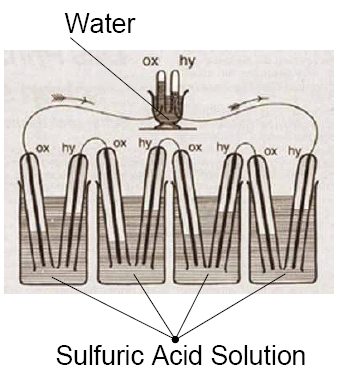
            Okay, okay, let’s slow down and re-wind to talk about where this came from. The idea for the fuel cell came from way back in 1838 when a man named Christian Friedrich Schönbein had some of his work published. Just a year later a hot-shot lawyer and scientist, Sir William Robert Grove, demonstrated then sketched a picture of a fuel cell. His sketch looked something like this below:


(Wiki)


Let’s give props to that guy. Now just skip a couple years and in 1955 W. Thomas Grubb (and a little later Leonard Niedrach) expounded on the idea that Schönbein and Grove had worked on so diligently. In the future, their work would lead to the use in Project Gemini (Wiki)
            Through more revisions of the fuel cell, Roger Billings finally developed the first hydrogen fuel cell automobile in 1991. And might I add: good on him. These fuel cell cars are so much more efficient then the most commonly used gasoline needing cars.
 I wouldn’t be surprised if most models of cars have the fuel cells within the next twenty years or 

so. What scientists have done to create such a thing is quite amazing. With all the dedication we 

might be able to stop (or at least slow down) our dependency on gasoline, especially from foreign 

countries.

Monday, November 28, 2011

Periodic Properties


Periodic Properties

“Eventually all the pieces will fall into place, until then... laugh at the confusion,
live for the moment and know that everything happens for a reason.”

            All the elements on the periodic table were set where they are for a reason. Believe it or not (and I hope you do) there is a formula for the placement. The 118 elements have been ordered into their exact spots through many processes.
            Every one of the elements in the table are organized  in an order from lightest to heaviest. This means that the elements whose atomic weights are near the same number will be very close together on the table. This was discovered and made popular by Demitri Mendeleev. As for columns, elements that have matching properties will be in the same column.
            As a simple principle, one can say, “The higher an electron’s energy, the farther from the nucleus it is.” (Colorado¹) What is it talking about right there? It’s saying that the atoms get bigger as you add electrons to higher energy levels. This chart shows the size of the structure of the atoms:
          
(Colorado²)
            Now, as you look at this picture questions might start to form in your head. Now, ignore those and listen to what I have to say. There are two main parts that go into this periodic table; Groups (or Families) and Periods (or Series). Families are the vertical arrangement of elements. Series are the horizontal arrangement of elements. Focus on the latter one mentioned. Now, in the table there are seven clear series. From left to right they are: alkali metals, alkaline earth metals, transition metals, halogens, noble gases, the lanthanide series and the actinide series. They all have different properties that I won’t go into because our class was quite enough that this should only be one page long.
            But on a side note, there is also a thing called sublevels. To read through them there is: s sublevel, p sublevel, d sublevel, and the f sublevel. These sublevels run on a energy based system. Respect the system.
            As we look at the innocent periodic table of elements we start to see patterns. Patterns that could only have been created and thought up by a mastermind. So enjoy these patterns and the simplicity they bring to your life before the mastermind starts to control our brains with what they have created. The end. (Omniscient¹¹)


Sources

Ÿ  Colorado¹ - http://www.colorado.edu/physics/2000/periodic_table/atomic_structure.html
Ÿ  Colorado² -http://www.colorado.edu/physics/2000/periodic_table/periodic_properties.html#size
Ÿ  Omniscient¹¹ - http://www.TheResourcesOfMySarcasticMind_HopeYouDon’tGetMad.org

Sunday, November 27, 2011

Curiosity, anyone?


Curiosity, anyone?
         Combining the forces of Mars Science Laboratory (MSL) and National Aeronautics and Space Administration (NASA) the two have come out with something grand. In a big step for human kind a rover has been prepared to land on Mars. Launched November 26, 2011, the rover is scheduled to land at Gale Crater on Mars in mid-August 2012. This rover’s task is to establish whether or not the Red Planet is or ever was able to support life.
          Imagine how you would feel if you got to name a famous space rover made by world renowned programs? That’s probably how Clara Ma felt when her essay with the suggested name Curiosity won the Mars Science Laboratory naming contest. The twelve-year old wrote a paragraph that caught the eye of many. Ma wrote:
Curiosity is an everlasting flame that burns in everyone's mind. It makes me get out of bed in the morning and wonder what surprises life will throw at me that day. Curiosity is such a powerful force. Without it, we wouldn't be who we are today. When I was younger, I wondered, 'Why is the sky blue?', 'Why do the stars twinkle?', 'Why am I me?', and I still do. I had so many questions, and America is the place where I want to find my answers. Curiosity is the passion that drives us through our everyday lives. We have become explorers and scientists with our need to ask questions and to wonder. Sure, there are many risks and dangers, but despite that, we still continue to wonder and dream and create and hope. We have discovered so much about the world, but still so little. We will never know everything there is to know, but with our burning curiosity, we have learned so much. (NASA)
Since then, Curiosity has been a long-awaited mission for science nerds everywhere. The answers that this rover promises humanity are the answers to some questions that have been around for a very long time.
          Curiosity is substantially larger than Spirit or Opportunity (the Mars Exploration Rovers that came before it). This rover is about the size of a Mini Cooper which makes it nearly five times as large. It also weighs a hefty 1,984 pounds (1600 lbs. more than the previous rovers). With all the weight and bulk, this rover’s estimated maximum terrain-traverse speed is 90 meters per hour. Please note like I have that during track season not one of CCHS’s athletes ran a 100 meter sprint in more than 30 seconds. So this is probably super slow and painful to watch. Over Curiosity’s two year mission it is anticipated to travel no less than 12 miles.
            The landing spot, Gale Crater, on Mars was chosen out of a list of places because of the different attributes it has. Inside Gale Crater is a mountain rising 3.1 miles of layered rock. Since the mission is to look for any sign of possible life on this planet, one of the first things Curiosity will be doing is taking a look at a very dense and bright colored rock. This kind of rock is different from all other rock types inspected on Mars. It might just be a piece of an antediluvian playa lake deposit. The rocks from there will be checked for the existence of organic molecules. (Wiki)
          Of course this crazily weighted will need insane amounts of power and I honestly think I should get extra-extra credit for writing this paragraph. Through the natural decay of a non-fissile isotope (see why I should extra-extra credit now? *nudge nudge*) of plutonium-238 generators produce electricity. Heat is given off by the decay regardless of the time of year or day. The heat is then turned into the electricity used to operate Curiosity. This method is an extremely smart move for NASA and MSL. Pu-238 has a half-life of 87.7 years giving it a long time to produce energy. (EPA)
          If Curiosity gets the answers that we hope to achieve from this then this will be a major breakthrough. And even though I still can’t get over how super-duper slow this little (kind of big) piece of equipment goes I even hope the best for it. I hope this report this report cured your curiosity of Curiosity (good pun, ay?). So tune in August of 2012 if you want an update on what this little rover has to offer.